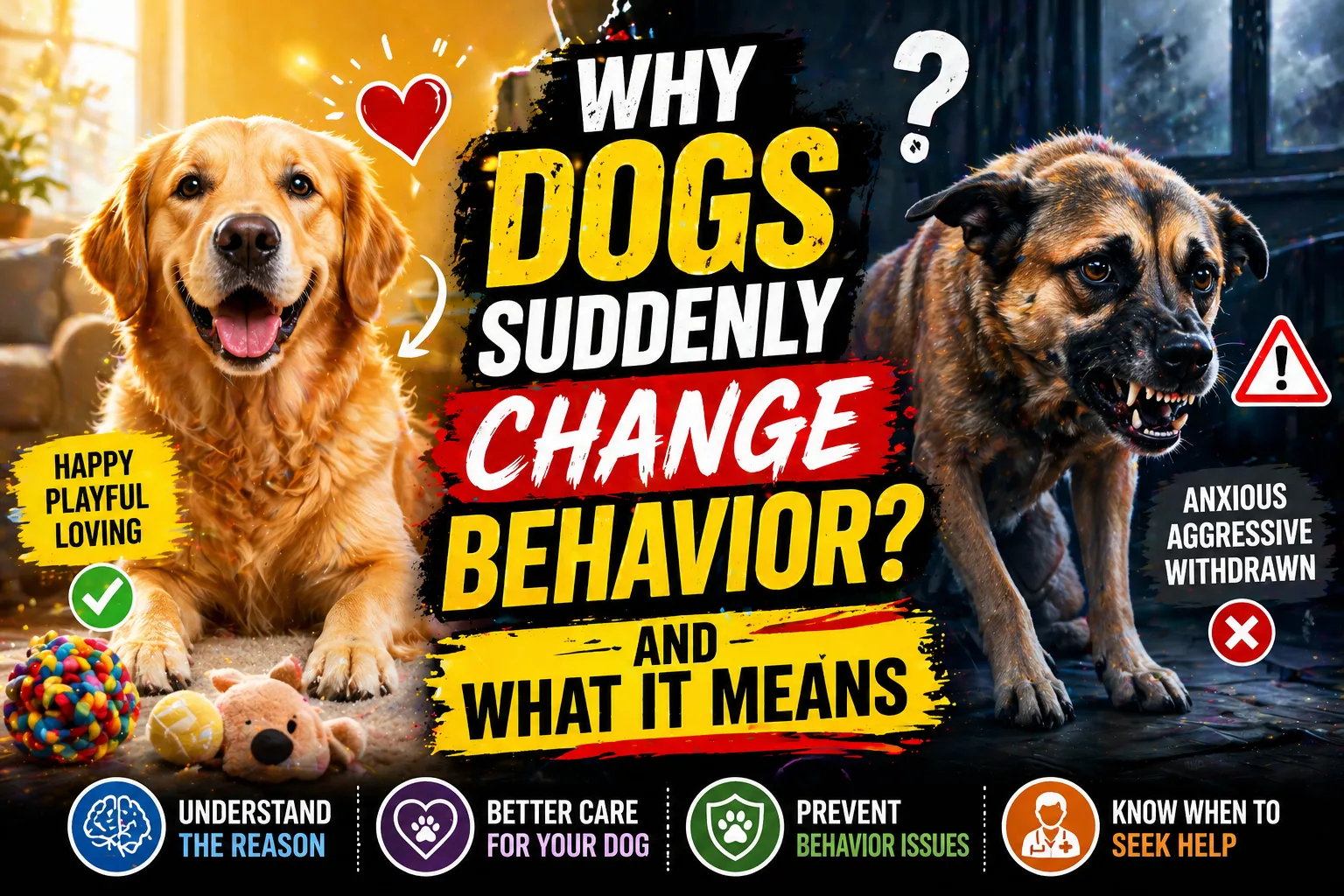
Learn why dogs suddenly change behavior, common causes, anxiety symptoms, and how to respond to sudden dog behavior changes effectively.
Did you know that a researcher at the Texas A&M College of Veterinary Medicine and Biomedical Sciences (VMBS) found that more than 99% of dogs in the United States exhibit potentially problematic behaviors?
Being a dog parent, it is difficult to see your pup exhibiting unusual behavior. Problems associated with physical health, mental stress, or environmental changes could be the reason for this problem.
Knowing this information will not only help you but also your canine friend.
In this article, you will get an idea about all the aspects, such as symptoms, cause, prevention, and visiting your veterinarian.
Understanding Sudden Changes in Dogs’ Behavior
Dogs are highly complicated creatures that display many different personalities and feelings due to various factors. Just like humans, dogs experience internal and external changes. Dog owners must identify such changes and immediately look for assistance.
Why Is My Dog Acting Differently?
If your dog is acting strange out of nowhere, your focus should be on a deeper analysis instead of a surface-level one. It is essential to get to the bottom of such behavior modifications to ensure that you still provide a conducive environment for your canine companion. The following are some of the things to check on:
- Physical Health: Much like how humans behave when they’re not feeling well, dogs experience the same thing.
- Emotional Stability: Any abrupt changes in the environment, shock, or stressful situations can influence their psychological state.
- Environmental Conditions: Moving out or having a new family member in the house might just be the reason why your canine’s behavior is different now.
Understanding these factors will help you navigate the direction of your dog’s treatment effectively. Veterinarians often rely on platforms like a trusted veterinary marketplace to access tools and resources that help them better diagnose and manage behavioral concerns.
Common Causes of Sudden Dog Behavior Change
Research suggests that up to 80% of pets with behavior problems such as aggression, pica, and noise sensitivity have underlying painful conditions. The following are some of the common causes of sudden dog behavior change. We have categorized the conditions into multiple broad categories to get a better understanding of symptoms
Medical Issues That Affect Dogs’ Behavior
Behavior changes could be due to many reasons. Before you take your dog to a behaviorist, get him thoroughly checked by his vet. The following are the possible medical reasons:
- Arthritis: Joint pain or inflammation is as painful for dogs as it is for humans. Dogs with arthritis show subtle behavior changes, such less they become less active and spending more time sleeping. Eventually, they start limping or become aggressive when touched, indicating the condition has worsened.
- Dental Diseases: Dental diseases are not easy to detect in dogs, as they keep eating without any sign of pain.
Other medical conditions include skin problems, urinary problems, spinal disease, pancreatitis, or, in severe conditions, cancer. In many cases, early support using the right animal care supplies, including health monitoring tools, mobility aids, dental care tools, or other supportive products, can help manage these underlying conditions more effectively.
Dog Anxiety Symptoms and Emotional Triggers
Different experiences could be exciting for your dog, but sometimes it causes them anxiety. You can identify anxiety symptoms through their body language. The following are the signs you should look out for.
- Mild Anxiety: It includes yawning, avoiding eye contact, licking lips, and turning the head away.
- Moderate Anxiety: It includes the mild anxiety symptoms as well. Additionally, fidgeting, refusing treats, furrowing brow, panting, and putting ears back are moderate anxiety symptoms.
- Severe Anxiety: It includes both mild and moderate symptoms, but also includes dilating pupils, staring, slinking or running away, tucking tail, and showing teeth.
Apart from these symptoms, losing interest in activities or not asking for playtime could be key indicators as well.
Environmental Changes and Routine Disruptions
Just as change can be challenging for humans, our dogs also find it tough. The following are some of the major changes that lead your dog to behave differently than usual.
- Moving Homes: Moving to a new home or undergoing renovations can cause stress for your dog.
- New Family Members or Pets: Dogs are very possessive about their owners or family. Whenever there is a new family member or pet in the family, due to unfamiliarity, they behave oddly around them.
- Changes in Routine: Changes in routine could significantly impact your dog’s behavior. This could trigger separation anxiety in them in situations of summer vacation or a pandemic.
Apart from these, look out for a decrease in appetite, destructive behavior, excessive barking, or isolation.
How to Respond to Dog Behavior Changes Effectively
You must also be careful and calm when your dog begins doing things differently. Rather than showing your emotions, keep in mind that any behavior change can be an indication that your dog is trying to communicate something, something is wrong, or something is not clicking.
Monitor and note Behavior Patterns
Record the time, place, and people (if any) of the behavior to determine the causes of the behavior. In addition, it is often possible to tell whether the problem is psychological or physical by observing the changes in eating, sleeping, and activity of the dog.
Make Environment and Routine Better
Keep to a routine of meals, walks, and playtime to make your dog less stressed and more secure. Provide the dog with a quiet and secure environment, where the dog can relax, be stimulated, and not be exposed to numerous sudden changes.
Use Positive Reinforcement Training
To make your dog behave well, use rewards like treats, praise, or playtime to encourage good behavior. Always avoid punishment, but instead make an effort to coax the dog out of bad behavior since the act will assist you to restore its confidence, besides reducing its anxiety.
Preventing Sudden Changes in Dogs’ Behavior
Stopping behavioral changes before they are set is much simpler than correcting them after the fact. A forward-thinking method centered on health, schedule, and emotional well-being will assist your dog to stay steady and have less random behavior.
- Regular Health Checkups: Regular visits to the vet can uncover the main health conditions before they manifest as changes in the dog’s behavior.
- Consistent Routine and Provide Proper Stimulation: Regular meal time, walk, and play are ways of lowering stress. Besides, exercising and mentally challenging dogs can be a foil to the boredom-related wrong behaviors.
- Support Emotional Health and Early Socialization: Proper interaction with other dogs and people, soft training, and an environment with low stress will make your dog more adaptable and less prone to anxiety-driven behaviors.
By prioritizing the preventive measures, not only do you lower the risk of your pet exhibiting sudden behavioral changes, but you are also making his life healthier and safer.
Conclusion
Sudden changes in dog behavior can be very worrying, but such changes are hardly ever baseless. In cases where the cause may be some kind of physical pain, emotional pressure, change in environment, or some other factor, these changes are your dog’s way of letting you know that something is not alright.
By carefully observing the signs, considering possible causes, and responding calmly and gently, you will be able to solve the problem properly.
FAQS
- Why did my dog start behaving strangely all of a sudden?
The sudden behavioral changes observed in pets can be considered an indication of the underlying medical issues, stress, anxiety, or any environmental or lifestyle modifications.
- What if my dog starts behaving strangely? Should I be worried?
Yes, in particular, if the change lasts for a long time or is a serious one, because it may be a sign of a medical or an emotional issue.
- Could my dog’s change of behavior be because of stress?
Indeed, stress is one of the main reasons for changes in behavior, and the dog can exhibit signs such as being restless, aggressive, or withdrawn.
- How to know when it is time to take my dog to the vet because of a behavior change?
If the behavior change is very sudden and strong, or accompanied by physical symptoms such as being very tired or losing your appetite, you should see a vet right away.
- Is it possible that dog training might help in solving sudden behavior problems in dogs?
Yes, repeated positive reinforcement through training can be of help in handling and improving various behavior-related problems gradually.